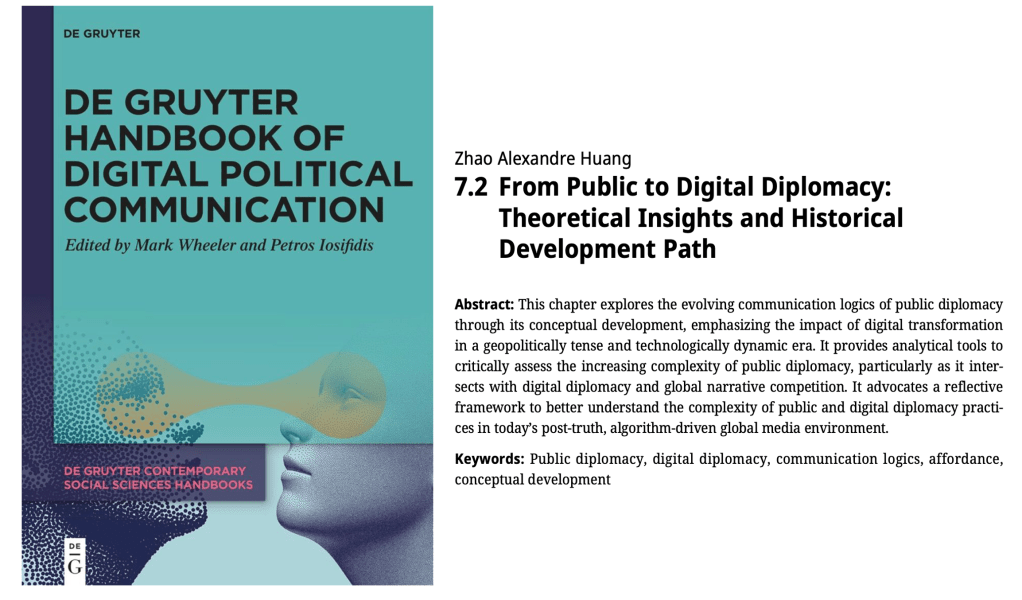
The first theoretical research output of the PubDiplo project has been published in the newly released De Gruyter Handbook of Digital Political Communication (ISBN: 9783111386034/9783111385952, Flyer here). Written by Zhao Alexandre Huang, the chapter, “From Public to Digital Diplomacy: Theoretical Insights and Historical Development Path,” traces the conceptual and historical transformation of public diplomacy and examines how digitalization has reshaped its underlying communication logics. Moving from Cold War propaganda and cultural imperialism to relationship management, platform affordances, and algorithmic mediation, the chapter argues that contemporary digital diplomacy combines multiple and sometimes contradictory modes of communication. It proposes a critical framework for analyzing how states, platforms, and publics compete over visibility, legitimacy, and narrative power in an increasingly fragmented geopolitical environment.
In early 2025, a series of apparently unrelated events brought public diplomacy and digital diplomacy back to the center of international debate. Following the release of DeepSeek, Beijing rapidly presented the Chinese artificial intelligence model as evidence of the country’s technological capacity. The communication surrounding the model also implicitly challenged the effectiveness of US technology restrictions and promoted an alternative vision of open technological development. In Paris, the international summit on artificial intelligence offered France and Europe an opportunity to articulate their own position on global AI governance. Across the Atlantic, cuts to US-funded international media, including Voice of America, prompted concerns that Washington was weakening one of the foundations of its global influence.
These developments show why public diplomacy can no longer be understood simply as the promotion of national culture, values, or foreign policy to overseas audiences. Platforms, algorithms, artificial intelligence, media infrastructures, and geopolitical rivalry now operate within the same communication environment. That is why digital diplomacy involves more than diplomats simply using social media. It signals a structural transformation in the production, circulation, and contestation of international influence.
Public diplomacy began as a technology of persuasion
The modern concept of public diplomacy emerged during the Cold War. It was initially conceived as an instrument of foreign policy and national security. Governments used international broadcasting, cultural programs, educational exchanges, and media campaigns to influence the attitudes of foreign populations. This model was predominantly vertical. States controlled the principal resources of international communication, while foreign publics were often treated as recipients of information, education, and persuasion. Public diplomacy consequently maintained an ambiguous relationship with propaganda, psychological operations, and ideological competition.
Its central question was relatively straightforward: how could a state organize information in ways that encouraged foreign societies to accept a particular political order, value system, or model of development? From this perspective, public diplomacy was never external to international power. It constituted one of the communicative forms through which that power was exercised. Information, culture, and knowledge became strategic resources in geopolitical competition.
The inequalities behind “cultural exchange”
Theories of cultural imperialism exposed the structural inequalities underlying this model of communication. During the Cold War, the United States and its allies possessed stronger international broadcasters, cultural industries, news agencies, and communication technologies. The “free flow of information” therefore developed within an asymmetric international environment. A limited number of powerful states acquired the ability to define the meaning of modernization, democracy, development, and legitimate international order. Other societies were positioned primarily as recipients of information, institutional models, and technological standards.
Public diplomacy could thus generate forms of information dependence. Target countries consumed cultural and news products originating from dominant powers, while also progressively adopting their institutional categories, technical standards, and political vocabulary. Unequal communication capacities could consequently be converted into broader forms of political, economic, and epistemic dependence.
This critique remains relevant in the platform era. The international communication environment has moved beyond broadcasting, yet its infrastructures remain highly concentrated. Search engines, social media platforms, cloud services, and generative AI systems increasingly function as the infrastructure of international communication. Control over these technologies affects which actors become visible, which voices are marginalized, and how global issues are categorized and interpreted.
From persuading publics to managing relationships
After the end of the Cold War, public diplomacy scholarship increasingly turned toward soft power and relationship management.
Globalization, transnational mobility, and the expansion of the internet weakened the ability of governments to control international information flows. Publics could no longer be treated simply as passive audiences. They could respond, contest, circulate, and reinterpret diplomatic messages. The objectives of public diplomacy consequently shifted. Influence depended increasingly on the capacity to sustain relationships, attract attention, establish credibility, and organize networks of communication. Listening, dialogue, interaction, trust, and the co-production of meaning became central concepts.
Social media accelerated this development. Comments, reposts, hashtags, mentions, emojis, videos, and user-generated content provided diplomatic institutions with new modalities of interaction. Foreign ministries and embassies could communicate directly with users, bypassing traditional media intermediaries. Digital platforms also destabilized the distinction between domestic and foreign communication. A single diplomatic message may simultaneously address citizens at home, foreign governments, diasporic communities, journalists, and globally connected platform users. This produces an “intermestic” form of diplomacy in which domestic and international politics become increasingly entangled.
Digital diplomacy does not automatically produce dialogue
The growth of interaction does not necessarily generate more equal communication. Platforms may facilitate public participation, while also enabling emotional mobilization, strategic manipulation, and propaganda. Users contribute to the production of meaning, yet their visibility remains conditioned by recommendation systems, commercial incentives, and platform governance.
Diplomatic institutions appear to operate within open communication environments. In practice, they depend on infrastructures designed and controlled by a small number of technology companies. This creates a central tension in digital diplomacy. It promotes the language of dialogue, participation, and relationship-building while intensifying competition among states, platforms, and political actors for attention and visibility.
The role of platform owners illustrates this transformation. When the owner of a social media platform can alter recommendation systems, amplify political content and intervene directly in electoral debate, the conventional relationship between governments, media, and publics no longer provides an adequate analytical framework.
The platform itself becomes a political actor. The chapter discusses Elon Musk’s use of X to support the German far right and attack its opponents. Such interventions cannot be analyzed through content alone. They also require attention to algorithmic modifications, ownership structures, and the political economy of visibility.
Rethinking the study of digital diplomacy
The analysis of digital diplomacy therefore requires several theoretical perspectives.
Relationship management can explain how diplomatic actors seek to build trust and maintain interaction. Propaganda studies reveal how states organize strategic persuasion. Cultural imperialism draws attention to inequalities in infrastructure, resources, and discursive power. Platform studies examine the institutional role of algorithms, data, and technology companies.
These approaches should not be treated as successive stages in which one model simply replaces another. Contemporary digital diplomacy combines several communication logics at the same time. Dialogue may serve persuasion. Interaction may be integrated into propaganda. Participation may reinforce state narratives. Apparently open platforms may create new forms of technological and informational dependence.
Research on digital diplomacy must therefore move beyond counting posts or evaluating whether a country’s narrative appears attractive. It must examine who controls communication infrastructures, who gains algorithmic visibility, how states and publics co-produce diplomatic meaning, and how domestic political conflicts enter the international communication arena. It must also ask how technological systems redistribute narrative power.
The transition from public diplomacy to digital diplomacy ultimately concerns more than a change of communication channels. It transforms the relationship between diplomacy, technology, and society. Under conditions of deep mediatization, communication infrastructures, institutional practices, and everyday interactions become increasingly interdependent. Understanding digital diplomacy has therefore become an essential way of understanding the changing organization of international power.
*The full version of this chapter is published in the De Gruyter Handbook of Digital Political Communication, edited by Mark Wheeler and Petros Iosifidis.
APA reference:
Huang, Z. A. (2026). From public to digital diplomacy: Theoretical insights and historical development path. In M. Wheeler & P. Iosifidis (Eds.), De Gruyter handbook of digital political communication (pp. 383–394). De Gruyter. https://doi.org/10.1515/9783111386034-033

