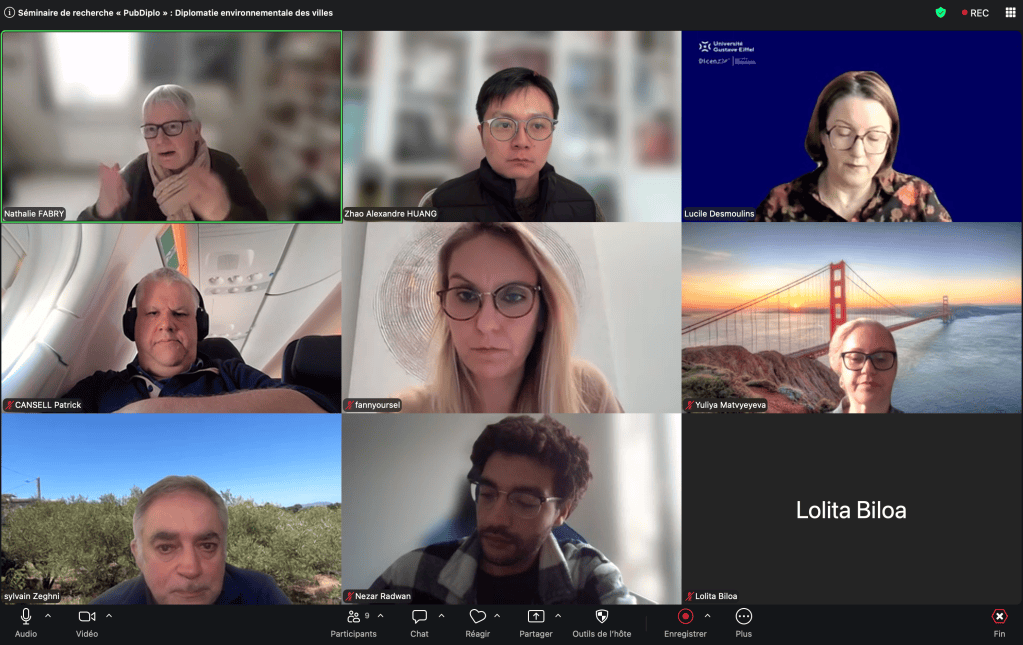
On 12 November 2026, PubDiplo hosted an online research seminar on “The Environmental Diplomacy of Cities.” As part of the 2026–2027 seminar series, Nathalie Fabry, Sylvain Zeghni and Zhao Alexandre Huang presented research associated with a special issue of the journal Mondes en développement.
Drawing on Colombian cases, Nathalie Fabry showed how cities in the Global South use transnational networks and the climate action agenda to strengthen their operational capacity, international visibility and recognition of adaptation and resilience priorities. Their influence nevertheless remains more operational than strategic, notably because of unequal access to funding and decision-making.
Through a comparison of six Southeast Asian cities, Sylvain Zeghni examined the uneven social effects of urban climate policies. Large technocratic projects promoted as “green” may displace environmental risks, encourage green grabbing and intensify the exclusion of vulnerable communities. His analysis therefore calls for urban transitions to be assessed through participation, territorial equality and environmental justice, rather than technical performance alone.
Based on a corpus of 2,406 posts published on X in 2025 by Xinhua, People’s Daily and CGTN, Zhao Alexandre Huang analysed the construction of China’s green discursive power. Cities, low-carbon infrastructure and environmental technologies are presented as material evidence supporting the legitimacy of a particular transition model. This process of “material-discursive normalisation” connects international communication, industrial strategy and the production of global norms.
Together, the presentations showed that urban environmental diplomacy is simultaneously a field of climate action, geopolitical competition and negotiation over legitimate models of transition.
Discussion with participants
The Q&A focused on who actually leads cities’ international engagement, the methods used in cross-national comparisons, financial and geopolitical dependencies, and the capacity of cities in the Global South to shape international norms. The discussion showed that urban diplomacy combines political representation, technical departments and public agencies, while local autonomy varies considerably in relation to central governments, funding institutions and economic elites.
A methodological exchange also clarified the use of international reports, local media, NGO sources and translation tools. Participants noted that cities in the Global South have rarely altered binding legal norms directly. Their influence is more visible in shifting priorities towards adaptation, resilience and qualitative evaluation criteria. On China, the discussion highlighted the growing use of concrete technological achievements to promote an industrial model of green transition internationally.

