Questioning Today’s Public Diplomacy
Inaugural Session: The International Presence of China
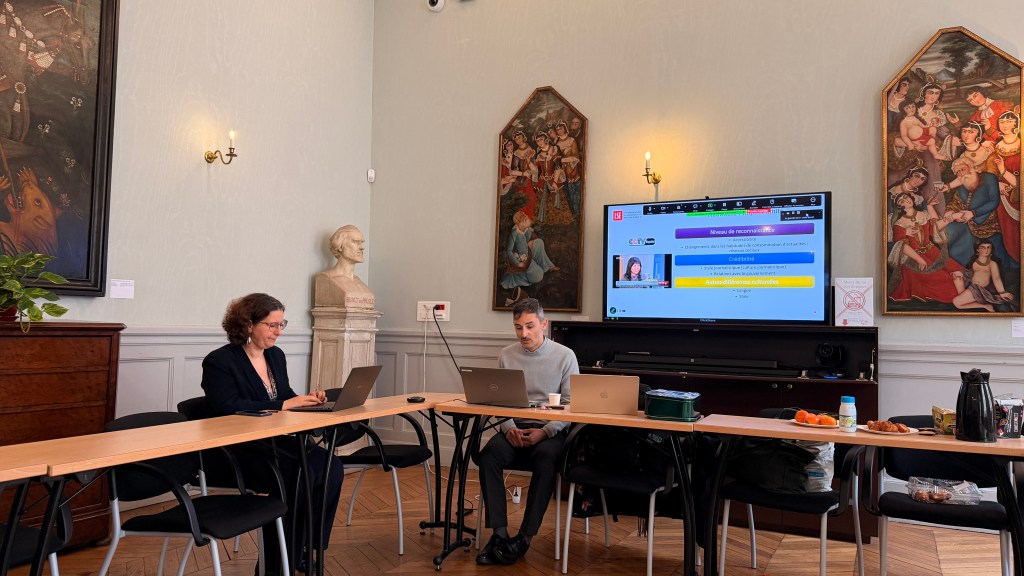
On Monday, March 16, 2026, the PubDiplo project successfully launched its Research Seminar Series entitled “Questioning Today’s Public Diplomacy” with an inaugural session held in the Salon Borel at INALCO’s Maison de la Recherche in Paris and simultaneously accessible online. Bringing together scholars from across Europe, the event marked the beginning of a structured series of academic exchanges dedicated to critically examining the contemporary transformations of public diplomacy.
Organized within the framework of the PubDiplo project—jointly funded by the French National Research Agency (ANR) and the Research Grants Council of Hong Kong (RGC)—this seminar series aims to provide a platform for theoretical, empirical, and methodological reflection on the evolving configurations of public diplomacy in the digital age. Over the past two decades, public diplomacy has undergone profound transformations. Once primarily conceived as a state-driven instrument of influence and image management, it now operates at the intersection of digitalization, platformization, and algorithmic mediation, within an increasingly competitive transnational environment structured by the circulation and contestation of narratives.
Beyond its strategic dimension, public diplomacy today also engages with cultural and heritage resources as vectors of symbolic projection and international legitimation. At the same time, it is shaped by participatory logics that reconfigure the modes of engagement between state and non-state actors, as well as the co-production of meaning across diverse publics. These shifts call for a reassessment of its analytical foundations: should public diplomacy be understood as a strategic communication apparatus, a discursive regime linking culture and power, a sociotechnical infrastructure organizing participation, or a space of normative negotiation at the global level? The seminar series is designed precisely to address these questions through a combination of conceptual discussions and empirically grounded case studies.
The inaugural session, entitled “The International Presence of China”, focused on China as a key analytical laboratory for understanding contemporary reconfigurations of public diplomacy. The discussions explored how China projects its influence internationally through a combination of discursive strategies, communication practices, and sociotechnical infrastructures. Particular attention was paid to the ways in which this influence is constructed, narrated, and legitimized across different regional contexts and digital environments.
The session featured a series of presentations examining China’s public diplomacy from multiple geographic and analytical perspectives. Mylène Hardy opened the seminar with an analysis of Chinese public diplomacy and influence in France, highlighting the articulation between symbolic, technological, and human networks. Claudia Astarita then addressed the Italian case, proposing key research questions and outlining a research agenda for assessing Chinese public diplomacy in Europe. Pablo Morales extended the discussion to Latin America, examining the evolving strategies and emerging challenges of China’s engagement in the region. Finally, Zhao Alexandre Huang explored the notion of “Chinese-style” tech diplomacy, analyzing the interplay between discourse, power, and legitimacy in global technological governance.
The session concluded with a collective discussion, allowing participants to engage with the theoretical and empirical issues raised throughout the morning. This inaugural event set the tone for the seminar series by fostering a rigorous and interdisciplinary dialogue on the transformations of public diplomacy in a rapidly evolving global communication landscape.
Through this initiative, the PubDiplo project reaffirms its commitment to advancing critical research on digital public diplomacy while strengthening international academic collaboration. The upcoming sessions in the 2026–2027 series will continue to explore key themes and case studies, contributing to a deeper understanding of how states navigate influence, communication, and legitimacy in the digital era.

